The PAL Pro Gripper
TIAGo Pro features, by default, a parallel gripper. This is a custom design of PAL Robotics.
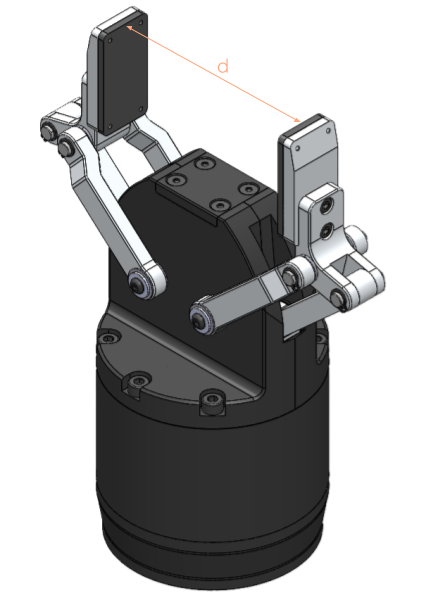
Figure 1: PAL Pro Gripper
The PAL Pro Gripper consists of a single joint whose value exposes the opening distance \(d\) between fingers, as shown in Figure 1.
Gripper Actuation and Force Characteristics
The PAL Pro Gripper is actuated by a single linear mechanism. Utilizing a custom ros2_control transmission interface, the finger opening distance \(d\), is exposed as the primary control parameter. Position control of the gripper is managed via an instance of the Joint Trajectory Controller.
The gripper's motor delivers a nominal torque of 0.3 Nm, which the transmission translates into a variable grasping force. This force is dependent on the gripper's configuration, ranging from 150 N when the fingers are fully closed to approximately 300 N when fully open.
Because the transmission is not backdrivable, direct torque or force control is not natively supported by the gripper hardware. However, users can implement grasping force limitation on the software side. The motor current is continuously published to the /joint_states topic, allowing users to monitor the applied effort and adapt the gripper's position commands to cap the exerted force dynamically.
Simulation of Reaction Forces
Figure 2 illustrates the simulated reaction force of the gripper system. The simulation setup involves applying a constant linear motion to a rigid body positioned between the fingers, with the resulting reaction force against the right finger being measured. Simultaneously, a constant opposing force is applied to the internal nut to simulate the motor torque resisting the movement.
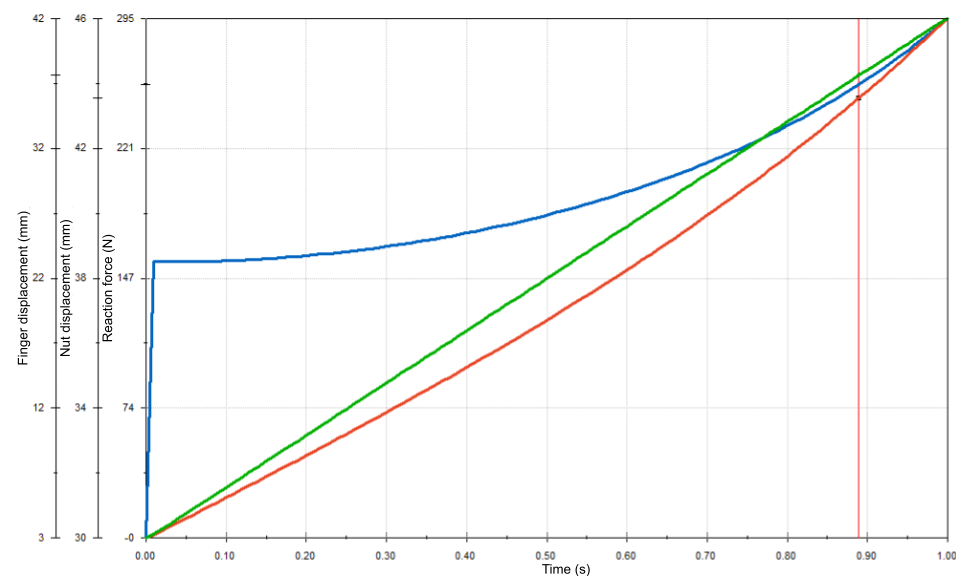
Figure 2: Force profile of the PAL Pro Gripper
The plot highlights the following variables:
- Blue: Reaction force (N)
- Green: Displacement of the finger
- Red: Displacement of the nut (driven by the motor)